
Payday Super in Australia: What It Means for Your Super
Payday Super is a change to Australia’s superannuation rules that takes effect on 1 July 2026. From that date, your employer must pay your super at the same time as your wages, not once a quarter. For anyone in contract, labour hire, or casual work, where super has been harder to track, this is a meaningful shift. …

By Charisel Dela Pena
Career Development• Job Seeker • June 22, 2026
Payday Super is a change to Australia’s superannuation rules that takes effect on 1 July 2026. From that date, your employer must pay your super at the same time as your wages, not once a quarter. For anyone in contract, labour hire, or casual work, where super has been harder to track, this is a meaningful shift.
How is super paid now, and what changes from 1 July 2026?
Right now, employers can pay super quarterly, with contributions due up to 28 days after each quarter ends. From 1 July 2026, super must be paid on every payday, and under the ATO’s Payday Super rules your fund must receive each contribution within 7 business days of payday.
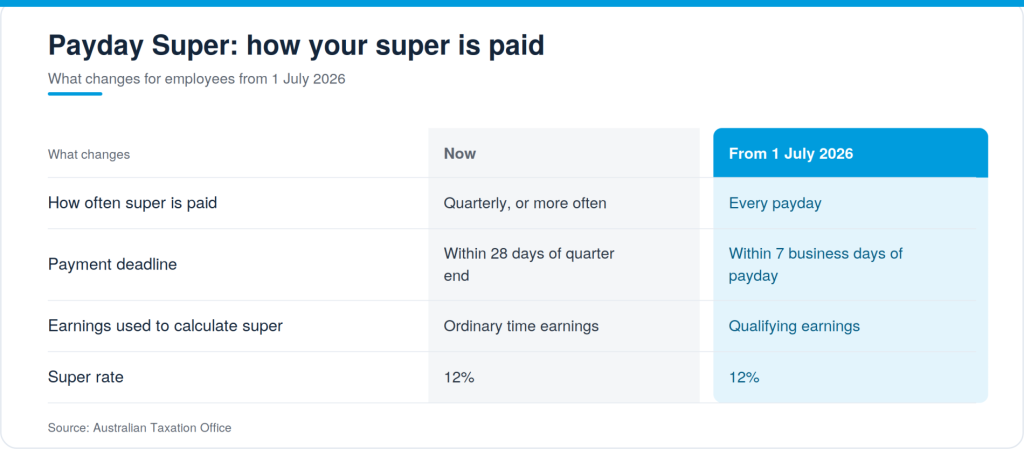
The super rate does not change; it stays at 12%. What changes is how often the money reaches your account and how it is calculated. One exception applies: for the first contribution for a new employee, or the first payment into a new fund, employers have a longer window of 20 business days, as set out in the ATO’s payment deadlines guidance.
What are qualifying earnings?
Qualifying earnings is a new term used to work out how much super you are owed. It brings together your ordinary time earnings with other payments such as commissions and salary sacrifice contributions. Super is still calculated at 12% of these earnings. For most people the difference is small, though it can mean a slightly larger contribution each pay.
Why is Payday Super good for your super balance?
Paying super more often gives your savings more time to grow. When contributions arrive every payday rather than quarterly, the money is invested sooner and compounds for longer, which over a working life can add up to a larger balance.
There is also more protection. The ATO tracks super payments through Single Touch Payroll, the same system used to report wages, giving it close to real-time visibility of whether super is paid correctly. The change aims to lift retirement outcomes and reduce unpaid super, as explained in the Treasury’s Payday Super policy. For casual or short-term roles, where late super has long been a problem, you are less likely to finish a job and find contributions missing.
How can you check your super is being paid correctly?
You can check your super yourself in a few minutes. Do this once Payday Super starts, especially if you change jobs or work for several employers.
- Log in to your myGov account, linked to the ATO, to see the contributions reported against your name.
- Check your super fund’s app or online portal to confirm payments are arriving and match your payslips.
- Watch the timing. From 1 July 2026, contributions should usually arrive within about a week of each payday.
- If something looks wrong, raise it with your employer first, then contact the ATO if it is not resolved.
The Fair Work Ombudsman’s summary of the new rules gives a plain-language overview of your entitlements.
Frequently asked questions
What is Payday Super?
Payday Super is a change to Australian super rules starting 1 July 2026. From that date, employers must pay super on the same day they pay wages, instead of quarterly. The rate stays at 12%, now calculated on qualifying earnings.
When does Payday Super start?
Payday Super starts on 1 July 2026, and applies to earnings paid from that date. For wages paid up to 30 June 2026, the existing quarterly super rules still apply.
How will Payday Super affect me?
You will see super paid every payday rather than every quarter. Your savings are invested sooner, which supports stronger growth through compounding, and you can more easily track whether your super is paid in full and on time.
Will I get super every pay cycle?
Yes. From 1 July 2026, eligible employees should receive super with every pay. Your fund must receive the contribution within 7 business days of payday. A longer 20 business day window applies to the first payment for a new job or into a new fund.
How can I check if my employer is paying super correctly?
Log in to myGov linked to the ATO and check your super fund’s app against your payslips. If super is missing or late, raise it with your employer, then the ATO.
Working with a recruiter who understands your entitlements
Payday Super is a reminder that pay and super matter when you take on a new role. Fuse Recruitment works with employers across insurance, manufacturing, and renewable energy who take their obligations to workers seriously. If you are looking for your next role and want a recruitment partner that keeps you informed, get in touch with our team.
This article is general information only and does not constitute financial advice. For your own circumstances, check the ATO or speak to a licensed financial adviser.
Related Content

Spring Clean Your Career: 7 Quick Wins Before Christmas
The days are longer, the wardrobe’s getting an overhaul, and there’s a natural pull to clear out what’s no longer serving you. Your career deserves the same attention. Think of this as your seasonal checklist for making the rest of the year work in your favour. Nothing here takes more than an hour or two,…

How to Build a Renewable Energy Workforce
Australia’s energy transition is moving fast. To hit the national target of 82 per cent renewable electricity by 2030, the country must build and operate a vast amount of new infrastructure, and that takes people. The Powering Skills Organisation’s 2025 Workforce Plan finds Australia needs around 42,000 extra energy trades workers by 2030, a workforce…

Building a Long-Term Career in Mortage Broking or Financial Advice
Here is a statistic worth pausing on. Fewer than 15,500 financial advisers now remain on ASIC’s Financial Advisers Register, even as demand for advice keeps rising. At the same time, mortgage brokers are writing a record 81 per cent of the nation’s new home loans. Across both fields, the message is the same. The people…
Related Content
Spring Clean Your Career: 7 Quick Wins Before Christmas
The days are longer, the wardrobe’s getting an overhaul, and there’s a natural pull to clear out what’s no longer serving you. Your career deserves the same attention. Think of this as your seasonal checklist for making the rest of the year work in your favour. Nothing here takes more than an hour or two,…
How to Build a Renewable Energy Workforce
Australia’s energy transition is moving fast. To hit the national target of 82 per cent renewable electricity by 2030, the country must build and operate a vast amount of new infrastructure, and that takes people. The Powering Skills Organisation’s 2025 Workforce Plan finds Australia needs around 42,000 extra energy trades workers by 2030, a workforce…
Building a Long-Term Career in Mortage Broking or Financial Advice
Here is a statistic worth pausing on. Fewer than 15,500 financial advisers now remain on ASIC’s Financial Advisers Register, even as demand for advice keeps rising. At the same time, mortgage brokers are writing a record 81 per cent of the nation’s new home loans. Across both fields, the message is the same. The people…

Why Digital Transformation Fails Without the Right People
Australian businesses are investing in technology at pace. New platforms, automation, data tools and AI are being rolled out across insurance, financial services, manufacturing, infrastructure and energy. The National AI Centre reports that 44 per cent of Australian small and medium businesses were using AI by February 2026, up from around 37 per cent a…

How to Retain Technical Talent in Regional Manufacturing
In Australia’s most remote areas, more than 80 per cent of employers say a job’s location is a reason they cannot attract enough applicants. For manufacturers in regional hubs, that is the daily reality. They compete with mining, construction and energy for the same skilled trades and technicians, often from a small local pool, and…

Why Infrastructure Careers Offer Long-Term Stability
Australia has a record $242 billion of public infrastructure in its forward pipeline, and is short around 141,000 of the workers needed to build it. For anyone weighing up a career, that single fact says a lot. The work is enormous, and the people who can do it are in short supply. Job security is…