
Trades Workforce Planning in Australia: Your FY2026-27 Hiring Plan
For trades and services businesses, the skilled labour shortage makes early workforce planning a competitive advantage, not an administrative task. Australia’s trades shortage is structural, and reactive hiring is consistently slower and more expensive than planned hiring. Confirming your FY2027 workforce needs in July, rather than when a site is already under pressure, is what…

By Charisel Dela Pena
Employer• Infrastructure • June 29, 2026
For trades and services businesses, the skilled labour shortage makes early workforce planning a competitive advantage, not an administrative task. Australia’s trades shortage is structural, and reactive hiring is consistently slower and more expensive than planned hiring. Confirming your FY2027 workforce needs in July, rather than when a site is already under pressure, is what secures the right people first.
Why is July the most practical planning window for trades businesses?
Because budgets reset on 30 June and the market tightens from Q2. Confirming labour hire volumes and direct hire needs for the first half of FY2027 in July lets you set preferred supplier arrangements before demand peaks and construction activity ramps up.
The broader labour market is easing. Jobs and Skills Australia found 29 per cent of occupations in shortage in 2025, down from 33 per cent in 2024. Trades are the exception. In construction, nearly half of trade occupations were assessed as in shortage in 2025. Apprenticeship intakes also need scoping early, so sourcing can begin sooner.
How do you map FY2027 workforce needs by project and site?
Map demand the way the work arrives: by site and project, and by whether the need is ongoing or temporary.
- Separate project-based demand (labour hire, contract) from permanent workforce needs, and confirm volumes for each by site for Q1 and Q2.
- Identify your highest-risk roles: hardest to fill, most critical to operations, and most likely to turn over. Make these your first priorities.
- For direct hires, build a sourcing timeline. Regional trade roles take three months or more to fill on average.
- For labour hire, review your preferred supplier panel and confirm volume expectations so your partner can pre-build a pipeline.
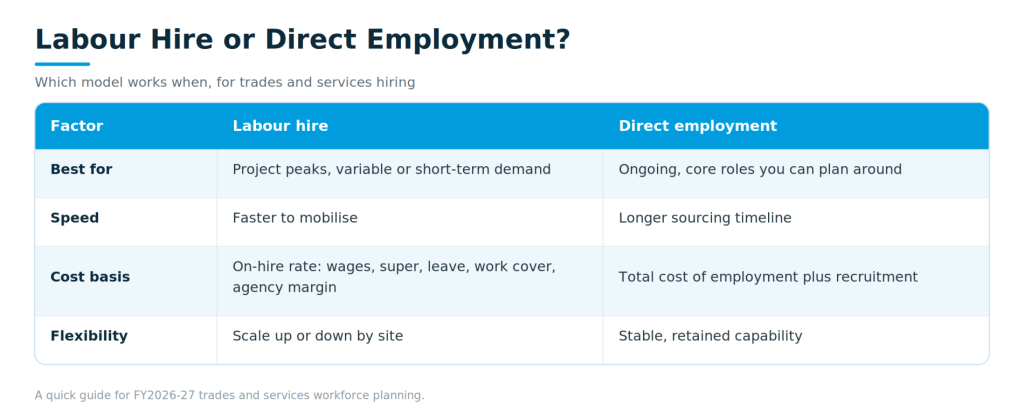
Labour hire or direct employment: which model works when?
Use labour hire for variable or short-term demand, and direct employment for ongoing core roles. Base the decision on total cost and how predictable the work is, not headline rates.
How do you budget for tradespeople and labour hire?
Budget on total cost, not headline rates, and build vacancy cost into the plan.
- On-costs for direct hire: base wages plus 12 per cent super, leave entitlements, payroll tax, work cover premium, and site allowances such as travel, accommodation, and PPE.
- Labour hire: compare total cost of engagement, including the agency margin, against total cost of direct employment.
- Vacancy cost: a skilled trades role vacant for 60 days carries a productivity impact that often exceeds the recruitment fee.
- Apprentices: wages are set by the relevant award. Budget for supervision time and the productivity ramp-up, not just the wage.
Which digital capabilities should trades businesses plan for?
Trades businesses increasingly compete on how efficiently they quote, schedule, and run sites, and digital tools drive all three. Planning for it in FY2027, rather than chasing it mid-project, keeps a business competitive as the sector modernises.
The roles to prioritise are those where trade skills meet digital tools. Estimators using digital take-off software and supervisors on project management platforms are increasingly sought after. The candidate pool is smaller than for traditional trades, so identify these roles early, and ask which roles need skills your current workforce lacks.
Frequently asked questions
Why is there a skilled trades shortage in Australia?
Trades take years to train, the workforce is ageing, and demand from housing, infrastructure, and energy projects is outpacing supply. Technicians and trades workers make up more than half of all occupations in persistent national shortage.
Should I use labour hire or direct employment?
Use labour hire for project peaks and variable demand, and direct employment for ongoing core roles. Compare total cost of engagement against total cost of direct employment rather than headline rates.
How do I budget for a trades role?
Use total cost: base wages plus 12 per cent super, leave, payroll tax, work cover, and site allowances such as travel, accommodation, and PPE. Build in the cost of a role sitting vacant, which often exceeds the recruitment fee.
Plan your FY2026-27 trades hiring with Fuse
Securing skilled tradespeople continues to be one of the biggest challenges for employers, making early workforce planning more important than ever. At Fuse Recruitment, we partner with businesses across construction, maintenance and field services, combining industry expertise with a practical understanding of the trades market to help clients build reliable workforces.
Whether you’re planning upcoming projects, forecasting labour requirements or reviewing your recruitment strategy, our team is here to provide market insights, practical advice and specialist recruitment support tailored to your business.
If you’d like to discuss your FY2026-27 hiring plans or learn more about the current trades talent market, get in touch with our team. We’d be happy to help you develop a workforce strategy that supports your operational goals and keeps your projects moving.
This article is general information only and does not constitute financial or tax advice. For your situation, check the ATO or a registered tax or financial adviser. The Fair Work Ombudsman also summarises the new rules and employer obligations.
Related Content

Spring Clean Your Career: 7 Quick Wins Before Christmas
The days are longer, the wardrobe’s getting an overhaul, and there’s a natural pull to clear out what’s no longer serving you. Your career deserves the same attention. Think of this as your seasonal checklist for making the rest of the year work in your favour. Nothing here takes more than an hour or two,…

How to Build a Renewable Energy Workforce
Australia’s energy transition is moving fast. To hit the national target of 82 per cent renewable electricity by 2030, the country must build and operate a vast amount of new infrastructure, and that takes people. The Powering Skills Organisation’s 2025 Workforce Plan finds Australia needs around 42,000 extra energy trades workers by 2030, a workforce…

Building a Long-Term Career in Mortage Broking or Financial Advice
Here is a statistic worth pausing on. Fewer than 15,500 financial advisers now remain on ASIC’s Financial Advisers Register, even as demand for advice keeps rising. At the same time, mortgage brokers are writing a record 81 per cent of the nation’s new home loans. Across both fields, the message is the same. The people…
Related Content
Spring Clean Your Career: 7 Quick Wins Before Christmas
The days are longer, the wardrobe’s getting an overhaul, and there’s a natural pull to clear out what’s no longer serving you. Your career deserves the same attention. Think of this as your seasonal checklist for making the rest of the year work in your favour. Nothing here takes more than an hour or two,…
How to Build a Renewable Energy Workforce
Australia’s energy transition is moving fast. To hit the national target of 82 per cent renewable electricity by 2030, the country must build and operate a vast amount of new infrastructure, and that takes people. The Powering Skills Organisation’s 2025 Workforce Plan finds Australia needs around 42,000 extra energy trades workers by 2030, a workforce…
Building a Long-Term Career in Mortage Broking or Financial Advice
Here is a statistic worth pausing on. Fewer than 15,500 financial advisers now remain on ASIC’s Financial Advisers Register, even as demand for advice keeps rising. At the same time, mortgage brokers are writing a record 81 per cent of the nation’s new home loans. Across both fields, the message is the same. The people…

Why Digital Transformation Fails Without the Right People
Australian businesses are investing in technology at pace. New platforms, automation, data tools and AI are being rolled out across insurance, financial services, manufacturing, infrastructure and energy. The National AI Centre reports that 44 per cent of Australian small and medium businesses were using AI by February 2026, up from around 37 per cent a…

How to Retain Technical Talent in Regional Manufacturing
In Australia’s most remote areas, more than 80 per cent of employers say a job’s location is a reason they cannot attract enough applicants. For manufacturers in regional hubs, that is the daily reality. They compete with mining, construction and energy for the same skilled trades and technicians, often from a small local pool, and…

Why Infrastructure Careers Offer Long-Term Stability
Australia has a record $242 billion of public infrastructure in its forward pipeline, and is short around 141,000 of the workers needed to build it. For anyone weighing up a career, that single fact says a lot. The work is enormous, and the people who can do it are in short supply. Job security is…